> For the complete documentation index, see [llms.txt](https://docs.lightact.com/llms.txt). Markdown versions of documentation pages are available by appending `.md` to page URLs; this page is available as [Markdown](https://docs.lightact.com/layers-and-layouts/layers.md).
# Layers
In this page we will explain 2 main approaches on creating a layer and talk about layer properties.
## Creating a layer
In LightAct, you can create a layer in 2 different ways:
* **Blank layers**
* **Layer templates**.
As you will mostly be using Layer templates, we will focus on them first.
### Layer Templates
Layer Templates are divided into 2 groups:
1. **Stock layer templates**, which are provided with every release of LightAct. More information about them is available [here](/layers-and-layouts/stock-layer-templates.md).
2. **User layer templates**, which you can create on your own, as per the [instructions](/layers-and-layouts/user-layer-templates.md).
### Blank Layers
{% hint style="warning" %}
Please note, building layers from scratch is designed for specific use cases and for advanced users. Before building a layer from scratch, please make sure there isn't already a layer template that does what you need.
{% endhint %}
{% hint style="info" %}
**Good to know**: the best way to learn advanced node programming is to attend an [Advanced training session](https://lightact.com/lightact-training/).
{% endhint %}
## Layer properties
Every layer has some properties which determine its behavior.
### Layer variables
Explained on [this page](/layers-and-layouts/layer-layouts/variables/layer-variables.md).
### Layer properties
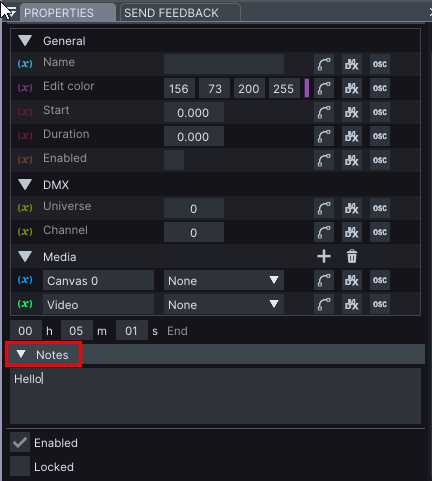
Each layer has an identical set of Properties. Among them are:
1. **End (HMSF)**: the time of the end of the layer
2. **State**: state of the layer:
1. *Enabled*: means the layer is enabled and will execute if the playhead is on it in an active timeline.
2. *Disabled*: means the layer is disabled and will never execute.
3. *Preview only*: means that the layer will execute but Render Texture nodes in them won't render to the mappings. This means that you can still preview the content of the layer in the thumbnail if you expand the track, but won't see the content rendered on the mapping (and therefore not on the outputs.
3. **Locked:** if checked, the layer is locked and cannot be edited.
4. **Fades**: explained in [Fade in and Fade ](/layers-and-layouts/fade-in-and-fade-out.md)out and [Cross-fade](/layers-and-layouts/cross-fade.md) pages.
### Layer Notes
You can add custom notes to every layer by first checking the **Notes** checkbox and then writing into the text box.
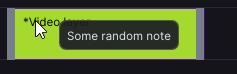
When you write a note, a \* symbol will appear next to the Layer name. If you hover over a layer with a mouse, the note will show up.