> For the complete documentation index, see [llms.txt](https://docs.lightact.com/llms.txt). Markdown versions of documentation pages are available by appending `.md` to page URLs; this page is available as [Markdown](https://docs.lightact.com/dmx/dmx-in/adjust-layer-variables-with-dmx.md).
# Controlling Layers with DMX
By default, every layer has **Universe** and **Channel** properties in the **DMX** variable group set to -1. This means that this layer is not controlled with DMX.
To map a layer to a particular DMX channel, just drag from that channel to the layer you want to map. In the background this will set the Universe and Channel variables.
## DMX Personality of a Layer
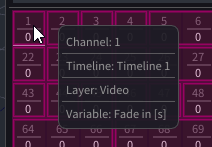
If you hover above a particular channel, the tooltip will tell you which layer and which variable is mapped to it.
{% hint style="info" %}
**Good to know**: all Stock Layer templates have DMX footprints already set up so you don't have to do anything.
{% endhint %}
Let's see how a DMX footprint of the layer is set up.
### DMX Properties of Layer Variables
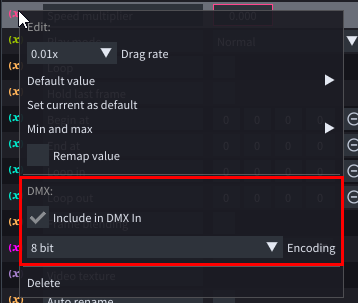
Whether a particular variable is included in the footprint is governed by the **Include in DMX In** checkbox in the right-click menu of the variable.
In this menu, you can also determine if this variable is 8, 16, 24 or 32 bit.
{% hint style="info" %}
**Good to know:** DMX control of certain variable types such as Mapping, Device and Asset is done through [Index Manager](/dmx/dmx-in/index-manager.md).
{% endhint %}
### DMX Flag of a Variable
If you want to temporarily disable DMX setting a particular variable, you can disable the DMX flag. This flag will turn green if that DMX variable is currently being set by DMX.
### Remap value
If **Remap value** is left unchecked, LightAct will set the value of the mapped variable to the raw value of the assigned DMX Channel.
If *Remap value* is checked, it will set the value of the variable based on the Min and Max values of this variable.
For example, let's say that:
1. Min and Max of a variable are 0 and 1000 respectively
2. incoming DMX value is 255
3. variable is going to be set to 1000
4. if the incoming value is 0, the variable is going to be set to 0.
### Exporting DMX Personality
To export DMX personality of a layer, open the Layer's layout and click on either **Export GDTF** or **Export PDF**.