> For the complete documentation index, see [llms.txt](https://docs.lightact.com/llms.txt). Markdown versions of documentation pages are available by appending `.md` to page URLs; this page is available as [Markdown](https://docs.lightact.com/dmx/dmx-in.md).
# Receiving DMX
*DMX In* window is a window where you can receive DMX data. By data we mean both the DMX channel values as well as Art-Net timecode.
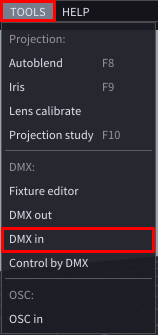
*DMX* *In* window can be found under **Tools -> DMX In**, under the *DMX* section.
## DMX In Setup
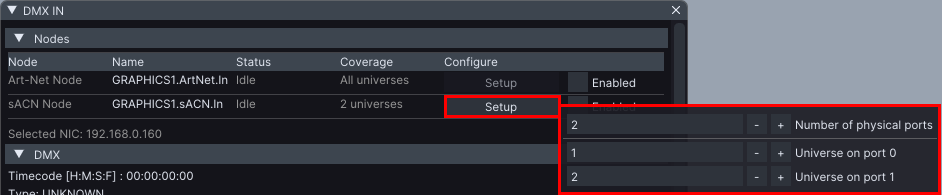
Listed under the **Nodes** section of the *DMX In* Window, you can find 2 nodes. One of them is an Art-Net node and the other one is an sACN node.
In *Configure* column you can define the number of ports we will be listening to, as well as which port is mapped to which universe. These parameters can usually be adjusted in real physical devices, as well.
After you click **Enabled checkbox**, the receiver node will be ready to receive *DMX Data*.
{% hint style="info" %}
**Good to know:** It is possible to receive data for both sACN and Art-Net nodes at the same time as well as multiple timecodes. Timecodes are available only for Art-Net protocol.
{% endhint %}
{% hint style="info" %}
**Good to know:** If you receive Art-Net timecode, you can also apply a timecode offset, which will affect all subsequent operations with this timecode.
{% endhint %}
## Controlling LightAct with DMX
Almost every part of LightAct can be controlled with DMX. For example:
* **Layer variables**: you can control all layer variables
* **Timelines**: most properties of timelines, such as fades, volumes, Cue triggers, Engaged status can be controlled with DMX
* **Master control**: master fade and volume and Global variables can be controlled.