> For the complete documentation index, see [llms.txt](https://docs.lightact.com/llms.txt). Markdown versions of documentation pages are available by appending `.md` to page URLs; this page is available as [Markdown](https://docs.lightact.com/layers-and-layouts/user-layer-templates.md).
# User Layer Templates
In LightAct, you can also create your own custom Layer Templates.
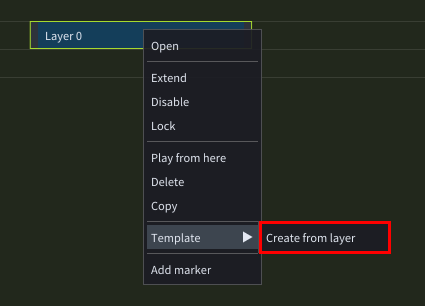
Any layer can be transformed into a Template, by right-clicking on it and selecting **Template -> Create from layer**.
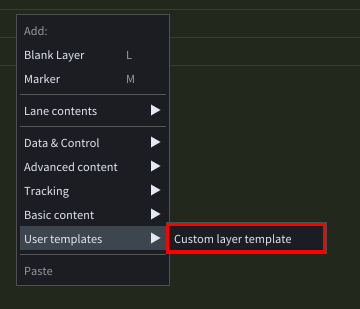
Once you give your template name and click on **Create** button, you will be able to see it in the Timeline track's right-click menu, under User templates.
{% hint style="info" %}
**Good to know**: For a User Layer Template to appear as a suggestion in the *Asset suggestion menu*, it should contain at least one of the following keywords: *Video*, *Image*, *Audio*, or *Notch* in its name.
{% endhint %}
## User Template Management
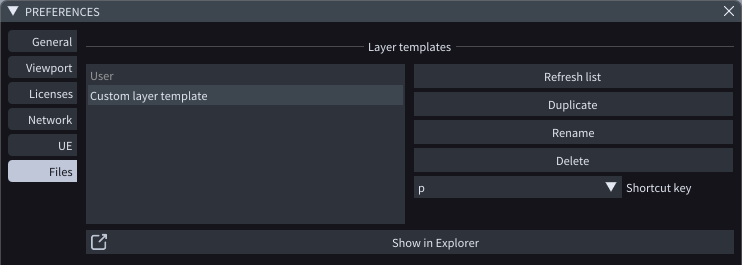
To manage your custom templates, go to **Edit -> Preferences Window** and expand the **Files** tab by clicking on it.
On the left-hand side of the *Layer Templates* section, all of your custom-created templates should be listed. Here, you can **Duplicate**, **Rename**, or **Delete** a selected *Template*. On top of that, you can also assign your own shortcuts, for their faster placement on the *Timeline tracks*.
{% hint style="info" %}
**Good to know**: Anytime you add or delete a template, the change should be visible upon clicking the **Refresh list** button.
{% endhint %}